
Traditional flat-fee SaaS pricing models fail to account for the variable costs of AI, putting margins at risk. In response, providers are turning to consumption-based, outcome-based, hybrid, and feature-tiered pricing. However, transitioning existing customers to new pricing models can be complicated given existing contractual terms. Legal considerations such as data privacy, data usage rights, and liability for AI hallucinations should also be considered.
The integration of artificial intelligence into SaaS products is transforming many industries, but it is also introducing economic challenges, namely variable costs that traditional flat-fee subscription pricing models cannot accommodate. Many SaaS providers are embedding third-party AI tools from providers like OpenAI and Anthropic or developing their own AI tools. Unlike traditional software features, AI workloads, especially those involving agentic AI, consume resources dynamically. AI-driven functionality incurs variable, often unpredictable, computing expenses such as cloud compute, data processing and third-party AI services. The result is a growing threat to profit margins, particularly for providers rolling out AI enhancements to existing customers locked into flat-fee contracts. Without the ability to adjust pricing in real time, these providers risk sustained margin compression until they can renegotiate terms with their customer base.
Customer expectations are also evolving alongside these technological changes. Customers are no longer satisfied with software access alone. Many demand tangible outcomes, such as automation, predictive analytics, and measurable cost savings. This shift is pushing SaaS providers to rethink their pricing strategies. Without this adaptation, many SaaS providers risk financial strain as AI-related expenses increase, especially when high-margins are insufficient to absorb growing costs.
AI introduces several cost drivers that disrupt the economics of traditional SaaS pricing. Cloud infrastructure, essential for running AI workloads, operates on a pay-as-you-go model, leading to variable and often unpredictable expenses. Data processing and storage costs also surge as AI models generate and consume massive datasets. Additionally, many SaaS providers rely on third- party AI services, such as OpenAI’s or Anthropic’s APIs, which are priced based on consumption metrics like token usage. These variable costs are not easily accounted for in flat-fee subscription models.
For SaaS providers with high margins, the immediate impact of these new variable costs may be manageable. However, as AI adoption scales, budget overruns may only become apparent later in the customer revenue cycle. The core issue is that traditional subscription models were not designed to handle the dynamic resource demands of AI, particularly agentic AI, which executes multi-step, adaptive workflows or computational costs. Without a way to pass these variable costs to customers, SaaS providers may find their profitability squeezed, especially if they cannot modify existing pricing structures.
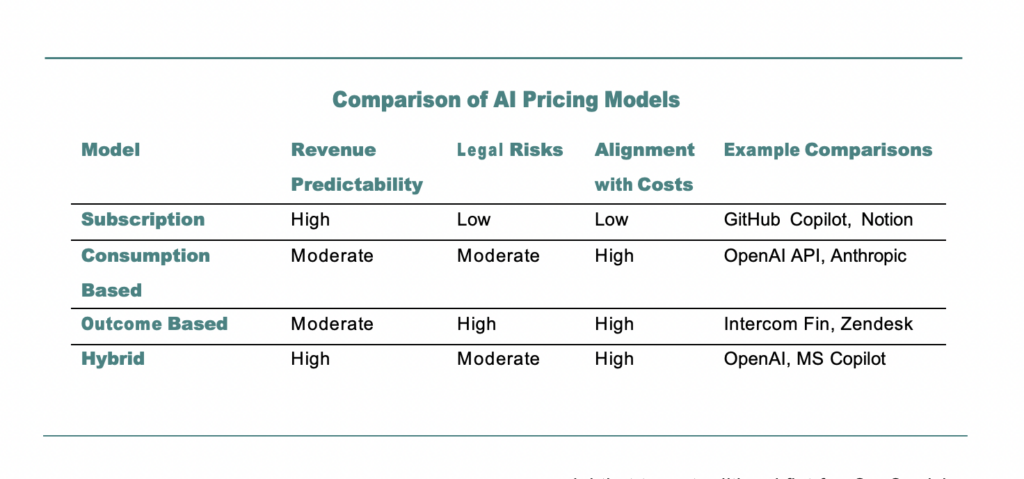
As the limitations of flat-fee subscriptions become apparent, several alternative pricing models are gaining traction. Each offers a different approach to aligning costs with the value delivered by AI, though they vary in complexity and customer acceptance.
Consumption-Based Pricing charges customers based on actual consumption, such as the number of tokens processed, API calls made, or compute time used. This model is particularly effective for API-driven AI services, where customers pay for usage such as per token or per API call. It aligns costs with value, lowers barriers to trial and adoption, and allows revenue to scale with consumption. However, it requires SaaS providers to implement accurate metering and billing infrastructure, as unpredictable consumption can lead to billing anxiety, especially for customers with fixed budgets.
Feature-Based and Tiered Pricing allows SaaS providers to bundle AI features into existing subscription tiers or offer them as premium add-ons. This model can increase average revenue per user by providing different levels of service with varying AI capabilities. GitHub Copilot’s pricing for AI coding demonstrates how this approach can work for users with predictable consumption patterns. However, it may leave money on the table for high-value use cases and frustrate heavy users who hit feature limits, feeling constrained by arbitrary caps.
Outcome-Based Pricing ties payment directly to measurable business results delivered by AI, such as the number of customer complaints resolved without human intervention. This model drives customer satisfaction by aligning pricing with actual business value, but it requires robust measurement and verification methods. Due to its contractual complexity, outcome-based pricing has seen limited adoption, though it is particularly effective for customer service applications.
Hybrid Pricing combines recurring subscription fees with metered consumption or outcome- based charges. This approach is ideal for workloads where a predictable base fee covers core functionality, while variable consumption fees capture the usage of AI functionality. OpenAI’s model, which includes a subscription with consumption credits and the option to purchase additional credits as needed, illustrates how hybrid pricing can balance predictability with flexibility. The challenge lies in integrating billing systems with metering infrastructure to ensure accuracy and transparency.
The rise of agentic AI, where autonomous systems execute multi-step, adaptive workflows, highlights the inadequacies of traditional flat-fee pricing. Under traditional subscription models, customers pay a fixed rate for what is assumed to be a predictable consumption of resources. Agentic AI shatters this assumption. A single user request, such as “automate my customer onboarding,” might trigger dozens of sub-tasks, including querying databases, generating documents, integrating third-party tools, and iterating based on real-time feedback. Each of these steps consumes compute resources, API calls, and proprietary model inferences, yet flat-fee pricing treats a simple chatbot query the same as a full- scale workflow automation.
This mismatch creates a licensing dilemma for SaaS providers. They must either undercharge power users, risking margin erosion as agentic workloads increase, or overcharge casual users, stifling adoption with costs that do not align with their actual needs. Worse, flat-fee models incentivize abuse, allowing customers to deploy agents for round-the-clock operations while paying the same as users running occasional tasks. The result is an unsustainable economic model that turns traditional flat-fee SaaS pricing on its head.
The core issue is the asymmetry between cost and value. Flat fees assume linear consumption patterns, but agentic AI’s resource demands are dynamic and often exponential. For example, a marketing team using an agent to draft a single email pays the same as one automating several campaigns with thousands of personalized variants. This misalignment discourages innovation, as providers may throttle agent capabilities to control costs. Traditional master services agreements, may lack mechanisms to account for the variable intensity of agentic workflows. Legal teams struggle to define “User” when every interaction could involve unpredictable compute, and sales teams grapple with pricing plans that either deter small customers or invite exploitation by large ones.
Consumption-based pricing resolves these challenges by tying costs to actual consumption. Instead of arbitrary tiers, customers pay for what they consume, whether that is agent runtime, API calls, or external tool integrations. This model mirrors cloud infrastructure pricing, where users expect to pay for compute time. It also fosters transparency, as detailed usage metrics allow customers to optimize spending while providers recoup costs without penalizing light users. Hybrid approaches, such as base subscriptions with metered overages, can ease the transition,offer predictability while accommodate demand spikes.
Without this shift, SaaS providers face a lose-lose scenario: either absorb the rising costs of agentic AI, risking profitability, or impose restrictive limits that undermine the technology’s potential. Consumption-based pricing aligns revenue with resource consumption, allowing SaaS providers to confidently invest in more capable agents, knowing that heavy users will fund their own demand. For agentic AI to thrive, pricing must evolve from one-size-fits-all subscriptions to flexible, consumption-driven models that reflect the true cost and value of autonomy.
Transitioning from flat-fee subscriptions to consumption-based pricing requires a thoughtful approach to avoid alienating customers. In certain respects, this transition could be thought of as a new sales motion where existing customers are educated on the possibilities of the new AI features and the value they stand to derive. When the value proposition is made clear, existing customers are more likely to transition from flat fee to consumption-based pricing. SaaS providers may want to consider a gradual approach to transitioning customers from flat-fee subscriptions to consumption-based models.
This allows customers to choose the level of functionality that suits their needs and budget, reducing resistance to change. For example, a project management SaaS provider could introduce an “AI Pro” tier that includes intelligent task prioritization, automated reporting, and natural language processing for voice commands. Existing customers can continue using the standard plan at current pricing, while those seeking AI-driven advantages can opt into the premium tier, justifying the higher cost through demonstrated value.
Add-Ons provide another strategy for smoothing the transition. By offering AI features as optional add-ons rather than bundling them into the core product, customers can maintain their existing flat-fee subscriptions while selectively adopting AI functionalities as needed. Over time, as customers recognize the value of these add-ons, they may be more willing to transition to consumption-based pricing that include AI features. This method also gives SaaS providers valuable data on which AI features are most popular, informing future pricing and product development decisions.
Communication and education are critical to successful adoption. Customers need to understand how AI enhancements will benefit them in the long term, whether through time savings, reduced errors, or other competitive advantages. Case studies and testimonials from beta testers can illustrate the tangible benefits of AI, making it easier for customers to justify additional costs.
The introduction of AI related features in a product introduces another layer of complexity. Most SaaS agreements include clauses governing pricing changes, auto-renewals, and termination rights, which can complicate mid-term pricing adjustments. For customers with locked-in pricing, SaaS providers may need to honor existing terms for the duration of the subscription term, offering non-AI versions of the product if necessary. During renewal cycles, SaaS providers can then reintroduce consumption-based pricing, provided they comply with any required notice periods for fee increases. Failure to do so may force SaaS providers to renew on existing terms for yet another subscription period.
For customers adopting consumption-based pricing, underlying documentation whether in the order form or master services agreement, should explicitly define the new pricing model, including billing metrics, usage caps, and potential cost fluctuations.Ambiguities in these terms can lead to disputes, chargebacks, or litigation. Additionally, some enterprise customers may require explicit consent before enabling AI features.Many customers understandably prohibit vendors from automatically rolling out AI features in their products, as they require time to vet these features against their internal data privacy and AI governance policies.
Data privacy and compliance risks must also be addressed. AI tools may require updates to data processing agreements (DPAs) to reflect the use of third-party AI tools. For example, if a SaaS provider embeds OpenAI’s tools within its product, the SaaS provider will need to update its DPA to identify OpenAI as a sub-processor thereby granting OpenAI the right to process customer data. Failure to do so could result in a violation of the notice and consent requirements found in the GDPR and many state data privacy laws. Customer agreements should also clarify data ownership rights and usage permissions for customer data, particularly if the AI features train on customer data.
Performance warranties are another critical area. AI outputs are not infallible and may produce hallucinations or inaccurate results. Customer agreements should include disclaimers stating that AI outputs may not be accurate and that customers retain responsibility for validating outputs. Without such protections, SaaS providers risk liability for inaccurate AI-driven outputs. Limiting liability for AI related errors is essential as SaaS providers introduce AI functionality in their products. Finally, indemnification clauses should protect SaaS providers from misuse of AI features, such as customers inputting sensitive or regulated data without proper safeguards.
The integration of AI and agentic workflows into traditional SaaS products demand a fundamental shift in pricing strategies. Flat-fee subscriptions, designed for static software, cannot sustain the variable costs of AI functionality. Consumption- based models, offer a sustainable path forward, aligning revenue with actual resource consumption. While the transition requires careful planning, clear communication, and robust legal safeguards, the long-term benefits and sustainable growth for traditional SaaS providers, make it a necessary evolution. By embracing these changes, SaaS providers can navigate the challenges of AI-driven transformation.
Solversa specializes in guiding SaaS providers through the complex transition to consumption-based pricing. Our expertise in AI-driven monetization strategies can support integration of usage-based, hybrid, or outcome-based models tailored to your business. We provide end-to-end support to minimize disruption and maximize revenue alignment.